NEWS
From September 15 to 17, 2017, Almaty hosted an International Cytology Tutorial. The event was organized by the Kazakh Institute of Oncology and Radiology (KazIOR) in collaboration with the Association of Clinical Cytologists of the Republic of Kazakhstan and the International Academy of Cytology (IAC), with support from the “Together Against Cancer” Public Foundation.
The tutorial was attended by 105 specialists, including cytopathologists, clinical cytologists, and cytotechnologists. Participants represented 18 regions of Kazakhstan, as well as Almaty. The course attracted attendees and experts not only from Kazakhstan but also from Armenia, Azerbaijan, and Russia, as well as international participants from Turkey, the USA, Qatar, New Zealand, Australia, and Canada.
Our Participation as a Golden Sponsor
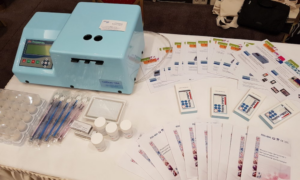
Our company proudly participated as a Golden Sponsor of the event. We showcased the CellScan 100A and BD (Becton Dickinson) systems. These diagnostic systems are global leaders in providing solutions for safe sample collection and transport, as well as reagents and diagnostic platforms for microbiological research. They play a critical role in detecting a wide range of infectious diseases, healthcare-associated infections (HAIs), and cancer.
Featured Innovations: M-kit
We also highlighted the M-kit culture medium for determining drug sensitivity to anti-tuberculosis drugs (The Korean Institute of Tuberculosis, South Korea).
- Validation: The National Reference Laboratory of the National Scientific Center of Phthisiopulmonology (NSCP) of the Republic of Kazakhstan issued a formal conclusion on the product.
- Results: Comparative testing of Drug Susceptibility Testing (DST) using the M-kit plate versus the BACTEC system and the Löwenstein-Jensen medium showed 100% correlation for both first-line and second-line drugs.
For more detailed information, you can refer to the article by A.M. Tolemisova, V.L. Bismilda, L.T. Chingisova, B.T. Toksanbayeva, and K.A. Suleimenova titled “Results of Researching Tests on the M-Kit Culture Medium,” published in the journal Laboratory Medicine (Issue No. 1(20), 2017).